XRP Back In The Spotlight As Mastercard Explores Ripple Technology
Alex Smith
4 months ago
Interest in XRP is once again gaining momentum after reports that global payments giant Mastercard is exploring collaboration opportunities with Ripple and its blockchain-based payment infrastructure. The development has drawn attention across the digital asset space, as partnerships between traditional financial institutions and blockchain firms continue to shape the evolution of cross-border payments.
What The Collaboration Could Mean For The XRP Ecosystem
An initiative from Mastercard is drawing significant attention to the role of blockchain technology in global payments, particularly to XRP. Crypto commentator Archie revealed on X that Mastercard has recently launched a Crypto Partner Program that brings together more than 85 companies from across the digital asset ecosystem. The partnership includes platforms such as Binance, PayPal, and blockchain firm Ripple to revolutionize the role of digital assets in global payments.
This powerhouse collaboration aims to connect blockchain-based technologies directly to Mastercard’s global payments infrastructure, spanning over 200 countries. Archie suggests that this type of initiative could support use cases such as seamless cross-border transfers, lightning-fast business-to-business payments, and more instant global payout systems.
Within that framework, Ripple’s expertise in on-chain solutions payment infrastructure places it in a strategic position for XRP as the go-to asset for real-world utility. As traditional finance giants like Mastercard and Visa move to integrate crypto, XRP is primed for explosive growth. This isn’t hype, it’s adoption in action.
Where XRP Could Fit In The Expanding Digital Payments Ecosystem
The scale of stablecoin activity is becoming one of the most overlooked developments in the digital asset space. An analyst known as XFinanceBull has highlighted that in 2025 alone, stablecoins processed an estimated $33 trillion in transaction volume, reflecting real payment activity rather than projections. This growth has been rapid, with total transaction volume rising 72% year over year while global user adoption reportedly surged 146% across 106 countries.
Several regional dynamics are helping drive this expansion. In Nigeria, a remittance economy estimated at $59 billion is increasingly interacting with digital dollar alternatives. In Turkey, demand for dollar-denominated stability amid currency volatility has driven the adoption of stablecoins into everyday use. Meanwhile, institutional settlement initiatives in the United Arab Emirates are also contributing to the growing role of blockchain-based payment infrastructure.
One of the fastest-growing segments is cross-border business-to-business payments, which expanded 733% to about $226 billion in transaction flows. According to XFinanceBull, this trend reveals a deeper shift in finance, and stablecoins are evolving beyond trading tools into a foundational layer for digital payments.
Within this evolving landscape, Ripple’s stablecoin initiative, RLUSD, has positioned its ecosystem directly inside this expanding liquidity layer. As stablecoins move globally, the networks providing settlement infrastructure may become strategically important.
Related Articles
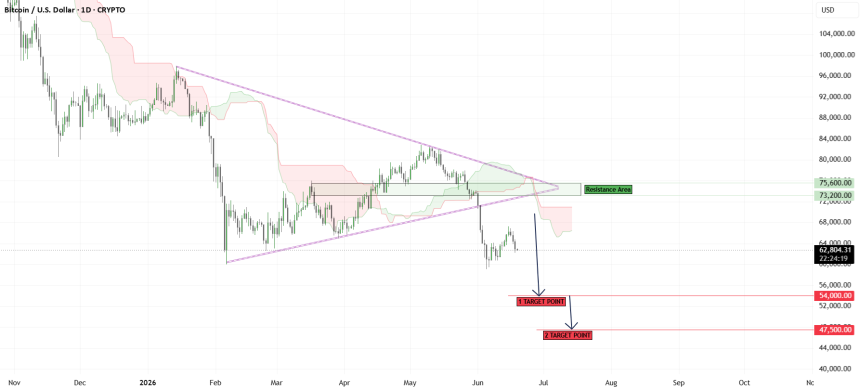
Bitcoin Bears Eye Lower Levels As TradingView Analysts Flag Failed Recovery
TradingView analysts warn Bitcoin's rebound may still be a resistance retest as...

Bitcoin Reclaims $63,500 As Traders Watch For Squeeze Toward $67,000
Bitcoin bulls are watching the $63,500 support zone as traders map a potential s...

Bitcoin Analysts Split Between Buyer Demand And Resistance Ceiling Near $65,000
Bitcoin analysts are split as BTC shows buyer demand but still faces a resistanc...

Bitcoin Faces Key $64,100 Resistance As Analyst Watches Fib Reaction Zone
An X analyst says Bitcoin is approaching local H4 resistance near $64,100, a lev...