Why Is This Solar Stock Overlooked Despite a 324% Profit CAGR, an ₹8,000 Cr Order Book, and a Low P/E?
Alex Smith
2 hours ago
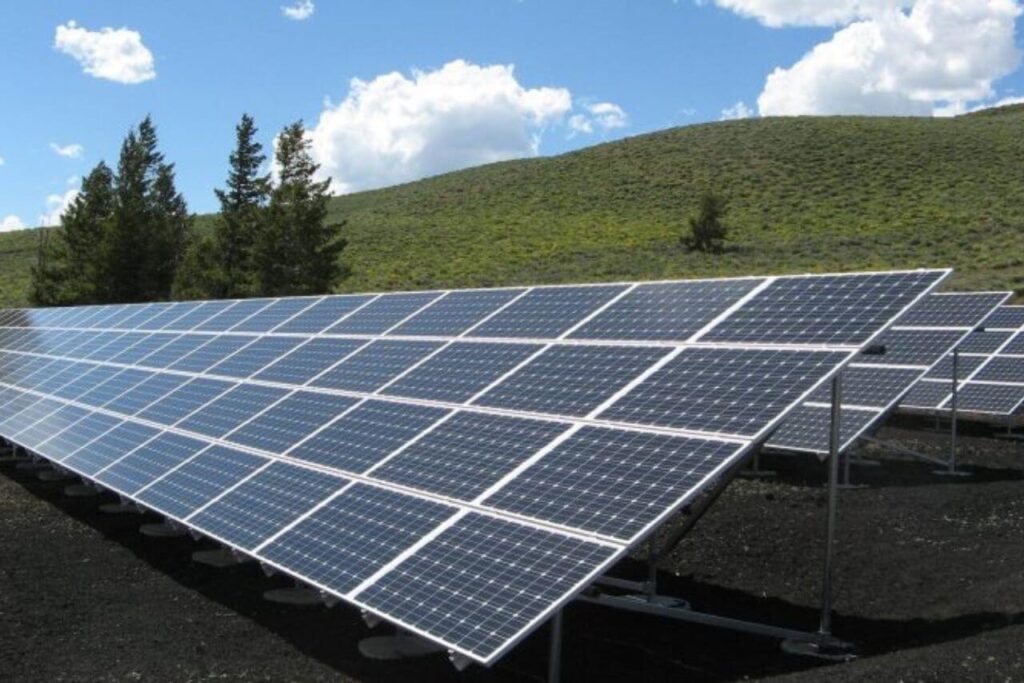
Synopsis: A little-known solar manufacturer just posted triple-digit revenue growth and a nearly 20-fold order book multiple, yet trades at roughly half the sector’s typical valuation multiple. Here’s what’s driving the story.
Amid India’s solar manufacturing push, one company has quietly scaled from a mid-sized module maker into a diversified clean energy platform. Strong execution, an expanding order pipeline, and a sharply improved balance sheet have caught analyst attention, even as near-term margins face pressure from global commodity swings.
Shares of Saatvik Green Energy Limited, with a market capitalization of Rs.5,947 Crore, closed at Rs.466.4 i.e. around 0.05% below its previous closing price of Rs.466.65. It trades at a P/E ratio of 16.42.
Record Financial Year Marks a Turning Point
Saatvik Green Energy Limited is an Indian solar photovoltaic module manufacturer that has expanded into a broader clean energy platform, with growing operations across solar cells, encapsulants, transformers, inverters, battery energy storage systems, and solar pumps. It is progressing toward full backward integration through its upcoming ingot, wafer, and cell manufacturing facilities in Odisha. It serves utility, commercial and industrial, and retail customers across India’s renewable energy sector.
Saatvik Green Energy closed FY26 with its best-ever annual performance. Revenue from operations came in at ₹4,548 crore, up 111% year-on-year, while profit after tax rose 64% to ₹357 crore – both the highest the company has reported. EBITDA grew 62% to ₹581 crore, translating into a 12.78% margin for the year. Production and sales volumes also hit new highs, with total output at 3,162 MW against 1,459 MW in FY25, and capacity utilisation staying healthy at over 84%.
The fourth quarter told a slightly different story. Revenue for the quarter touched ₹1,607.7 crore, its highest ever on a quarterly basis, but EBITDA and PAT came in lower at ₹116.6 crore and ₹60.4 crore respectively. Management attributed the compression to a sharp rise in silver, aluminium and oil-linked input costs, along with rupee depreciation against the dollar, all of which squeezed margins on fixed-price orders signed before the cost spike.
Despite a 324% three-year profit CAGR, the stock trades at a P/E of 16.45, well below the peer median of 30.77 among comparable solar manufacturers, some of which command multiples of 80x to 200x. Its ROCE of 32.92% also beats the peer median of 20.3%, raising the question of whether this valuation gap is justified.
Order Book Worth ₹8,000 Crore Offers Revenue Visibility
The company ended the year with a confirmed order book of 5.89 GW, valued at approximately ₹8,000 crore. Management indicated an 18-month execution timeline for most of this book, with large utility orders making up close to 65% of the total. These utility orders tend to carry pass-through arrangements for cost fluctuations, while the remaining commercial and industrial orders are largely fixed-price, leaving the company to absorb some cost volatility on that portion.
Building Toward Full Backward Integration
A key part of the company’s long-term strategy is reducing its reliance on imported components. It has scaled up its planned solar cell manufacturing capacity from 4.8 GW to 6 GW, split across two phases of 2.4 GW and 3.6 GW. The first phase is nearing completion, with equipment move-in scheduled to begin in June and July, and commercial cell production expected to start soon after. The second phase is targeted for mid-2027.
The company is also entering ingot and wafer manufacturing with a planned 6 GW capacity, and has expanded its encapsulant manufacturing roadmap from 2 GW to 5 GW following the commissioning of its Ambala facility. Management noted that in-house encapsulant production is already delivering cost savings of 5% to 10% versus external sourcing.
Diversification Beyond Solar Modules
Beyond its core module business, the company has been building out several adjacent verticals. It entered transformer manufacturing through an 80% stake acquisition, launched a new series of on-grid inverters, and set up a dedicated subsidiary focused on battery energy storage systems.
Its solar pump business, tied to rural electrification programmes, has also gained momentum during the year. Together, these initiatives are aimed at creating a broader, more integrated energy solutions platform rather than a single-product manufacturing model.
Balance Sheet Strength Supports Expansion Plans
Despite the scale-up in capital spending, the company’s financial position has improved. Its debt-equity ratio fell to 0.65 from 1.34 a year earlier, giving it more room to fund upcoming capex. Management has guided for capital expenditure of around ₹1,700 crore in FY27 for the cell expansion, followed by another ₹1,800-2,000 crore in FY28 tied to the ingot and wafer project. Even with this investment cycle, the company expects its debt-equity ratio to stay within a range of 1 to 1.5 times.
Outlook: Near-Term Pain, Longer-Term Opportunity
Management has been candid that margins will likely stay under pressure in the first half of FY27 due to ongoing commodity and currency volatility, but expects a meaningful improvement in the second half as the new cell capacity ramps up and cost pass-through mechanisms normalise. Whether the current valuation gap versus peers persists will likely hinge on how smoothly the company executes this transition from module assembler to a more vertically integrated manufacturer.
Disclaimer: The views and investment tips expressed by investment experts/broking houses/rating agencies on tradebrains.in are their own, and not that of the website or its management. Investing in equities poses a risk of financial losses. Investors must therefore exercise due caution while investing or trading in stocks. Trade Brains Technologies Private Limited or the author are not liable for any losses caused as a result of the decision based on this article. Please consult your investment advisor before investing.
The post Why Is This Solar Stock Overlooked Despite a 324% Profit CAGR, an ₹8,000 Cr Order Book, and a Low P/E? appeared first on Trade Brains.
Related Articles
FMEG vs Wires and Cables: Which Business Contributes More to Polycab’s Growth?
Synopsis: Polycab delivered another strong quarter, with both its core Wires ...

8 Stocks Powering India’s Vande Bharat Revolution; Do You Own Any?
Synopsis: India’s Vande Bharat expansion is creating opportunities across...

Can This Small-Cap Retailer Become the DMart of Ethnic Wear?
Synopsis: A South Indian ethnic wear retailer has scaled from a single store to...

5 Stocks with Rising EPS and a Low PEG Ratio to Add to Your Watchlist
Synopsis: Companies with improving earnings and low PEG ratios can indicate grow...