New Hope For Crypto: Senators Introduce Blockchain Regulatory Certainty Act
Alex Smith
5 months ago
In a major new development for the crypto industry, Senators Ron Wyden and Cynthia Lummis announced on Monday evening the introduction of a bipartisan, standalone version of the Blockchain Regulatory Certainty Act (BRCA).
This legislation aims to provide much-needed clarity for software developers and infrastructure providers in the blockchain space, particularly concerning their classification under federal law.
New Crypto Bill To Protect Blockchain Developers
According to the detailed press release regarding the matter, the BRCA specifies that developers and providers who do not have control over user funds will not be classified as money transmitters. Senator Lummis highlighted the ongoing challenges faced by blockchain developers, stating:
Blockchain developers who have simply written code and maintain open-source infrastructure have lived under threat of being classified as money transmitters for far too long. This designation makes no sense when they never touch, control, or have access to user funds, and unnecessarily limits innovation.
Lummis emphasized that the bill provides developers with the clarity needed to advance digital finance without the fear of legal repercussions for activities that do not pose a money laundering risk. Lummis added, “It’s time to stop treating software developers like banks simply because they write code.”
Senator Wyden echoed these concerns, arguing that imposing the same regulatory requirements on developers as those applied to exchanges or brokers is fundamentally flawed.
Main Highlights Of The BRCA
The Blockchain Regulatory Certainty Act aims to set clear federal standards defining when blockchain developers and service providers can be exempt from money transmitter regulations.
Under current legislation toward crypto, the Senators assert blockchain developers face regulatory ambiguities that have not only stifled innovation but also driven many projects offshore, as they navigate conflicting regulations across different states.
The bill specifically establishes that a “non-controlling developer or provider” refers to any entity that develops or maintains distributed ledger technology but does not possess the unilateral authority to initiate or execute transactions involving users’ digital assets without third-party consent.
In addition, the crypto bill clarifies protected activities, including the development or publication of software for distributed ledgers, maintenance services for blockchain networks, offering customer self-custody solutions, and providing necessary infrastructure to support distributed ledger services.
Importantly, while the bill allows states to enforce their laws consistent with federal regulations, it also prevents them from imposing money transmitter requirements on developers engaged solely in the specified protected activities.
Featured image from DALL-E, chart from TradingView.com
Related Articles
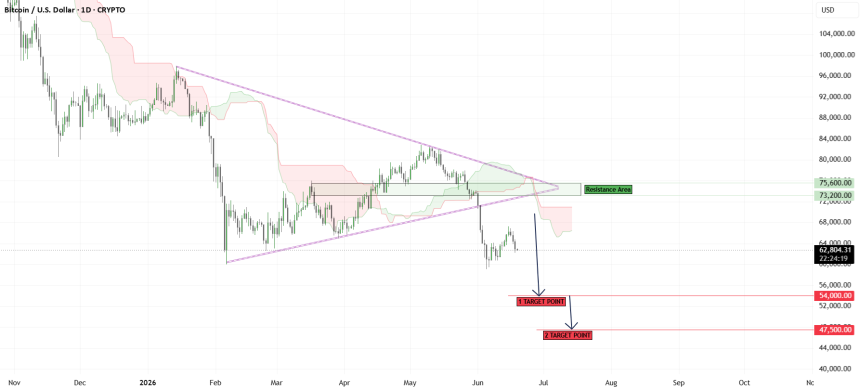
Bitcoin Bears Eye Lower Levels As TradingView Analysts Flag Failed Recovery
TradingView analysts warn Bitcoin's rebound may still be a resistance retest as...

Bitcoin Reclaims $63,500 As Traders Watch For Squeeze Toward $67,000
Bitcoin bulls are watching the $63,500 support zone as traders map a potential s...

Bitcoin Analysts Split Between Buyer Demand And Resistance Ceiling Near $65,000
Bitcoin analysts are split as BTC shows buyer demand but still faces a resistanc...

Bitcoin Faces Key $64,100 Resistance As Analyst Watches Fib Reaction Zone
An X analyst says Bitcoin is approaching local H4 resistance near $64,100, a lev...