Maruti Suzuki: Can The Indian Auto Giant’s Stock Ever Hit ₹17,000 Again?
Alex Smith
2 hours ago
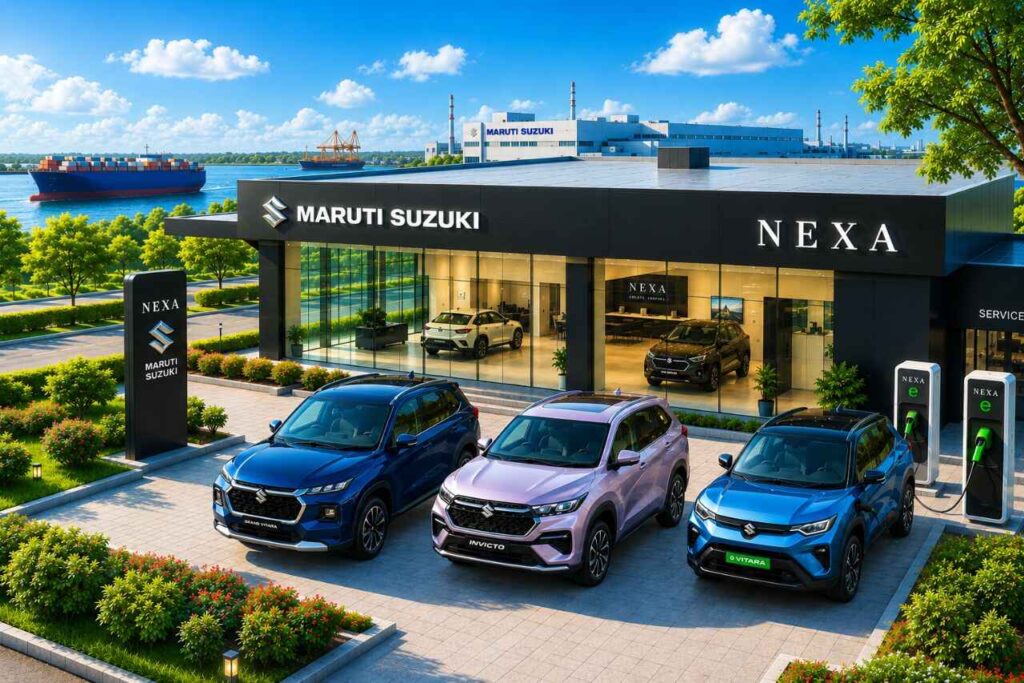
Synopsis: Maruti Suzuki’s stock is nearly 20 percent below its all-time high, but the company’s story may be changing faster than the share price suggests. From record exports and SUV expansion to electric vehicles and massive capacity additions, several pieces are beginning to fall into place. So, can India’s auto giant eventually climb to Rs. 17,000 again, or is that target still too far away?
A passenger vehicle stock that once looked like a steady compounding machine has corrected from its peak, even as the company is now showing signs of stronger volume momentum, export growth and a wider technology roadmap.
Maruti Suzuki currently trades around Rs. 13,800 levels, well below its all-time high of Rs. 17,370. While the stock has struggled to regain momentum, the company has spent the past year strengthening multiple growth engines across SUVs, exports, electric vehicles and manufacturing capacity. Are these developments enough to justify a move back towards Rs. 17,000, or does the company still have more to prove?
What Changed In FY26?
FY26 was not a simple year for Maruti Suzuki. The first half was weak, while the second half saw a sharp recovery after the government’s GST reform. In Q1FY26, the domestic passenger vehicle industry was sluggish, with wholesales declining by about 1.4 percent year-on-year. Entry-level affordability remained a concern, hatchback share continued to shrink, while SUVs and MPVs kept gaining share.
This was a problem for Maruti because the company has historically been very strong in small and compact cars. In Q1FY26, Maruti sold 5,27,861 vehicles, including 4,30,889 domestic units and 96,972 export units. Domestic sales declined 4.5 percent, but exports grew 37.4 percent, helping total volumes grow 1.1 percent. The simple reading was that India was still weak, but exports were saving the quarter.
Q2FY26 was unusual. Maruti sold 5,50,874 units, with domestic sales of 4,40,387 units and exports of 1,10,487 units. Domestic sales declined 5.1 percent because customers delayed purchases ahead of GST-related price reductions, but exports grew 42.2 percent. The company also started production of its first battery electric vehicle, the e Vitara, for India and over 100 global markets. This was also the quarter when Victoris was launched, strengthening Maruti’s position in the high-growth SUV segment.
The real turnaround came in Q3FY26. The passenger vehicle industry, which had declined 0.4 percent in the first half, grew 20.5 percent in Q3. Maruti’s domestic sales growth bounced back to 22 percent, compared with a 5.8 percent decline in the first half. Management said the primary driver was the small car segment in the 18 percent GST bracket. The company also recorded its highest-ever quarterly retail sales of about 6.84 lakh units and ended the quarter with just 3 to 4 days of network inventory.
Q4FY26 then confirmed that the recovery was not just a festive-season spike. Maruti sold 6,76,209 units in the quarter, up 11.8 percent year-on-year. Net sales rose 28.9 percent to Rs. 50,078.7 crore, while operating EBIT rose 30.4 percent to Rs. 4,409.2 crore. However, PAT declined 6.9 percent to Rs. 3,590.5 crore due to lower non-operating income and mark-to-market impact (Rs. 750 crore) on its invested surplus.
The Rs. 17,000 Question
The stock hitting Rs.17,000 again is not about whether Maruti can sell cars. It already can. The bigger question is whether Maruti can grow profit faster than volumes.
For FY26, the company sold 24.22 lakh vehicles, up 8.4 percent from the previous year. Net sales grew 20.2 percent to Rs. 1,74,369.5 crore. However, operating EBITDA grew only 6.5 percent, operating EBIT grew just 1.2 percent, PBT declined 2.8 percent, and PAT grew only 1 percent to Rs. 14,445.4 crore.
This is the biggest issue. The top line is growing, but profit growth is not yet exciting enough. Material cost as a percentage of net sales increased from 73.8 percent in FY25 to 75.9 percent in FY26. Operating EBITDA margin declined from 13.9 percent to 12.3 percent, while PAT margin fell from 9.9 percent to 8.3 percent. So, if the stock has to reach Rs. 17,000 levels again, the company must show that the margin pressure is temporary and operating leverage can come back as volumes rise.
The May 2026 update is encouraging. Maruti sold 2,42,688 units in May 2026, its highest-ever monthly sales volume. Domestic sales also hit an all-time high of 1,93,535 units, while exports stood at 41,914 units. Total sales rose 34.8 percent from 1,80,077 units in May 2025. Domestic sales including OEM and Total exports both grew around 34 percent.
More importantly, the growth was broad-based. Passenger cars grew from 68,736 units to 97,830 units, a rise of 42.3 percent. Utility vehicles grew from 54,899 units to 79,267 units, up 44.4 percent. This matters because the Maruti story needs both sides to work. It needs small cars to recover because that is its legacy strength, and it needs SUVs to grow because that is where the market has shifted.
The SUV And Premium Push
The most important change in Maruti’s business is that the company is trying to move beyond the old image of being only a small-car company. This is necessary because India’s passenger vehicle market has changed. Buyers no longer only want affordable hatchbacks. They want SUVs, premium interiors, safety features, larger screens, connected technology and better road presence.
Maruti has started responding to this shift. In Q1FY26 Maruti’s management said, The Grand Vitara became the fastest mid-SUV to reach 3 lakh sales. Fronx became the fastest SUV from India to cross 1 lakh exports. By Q2FY26, Jimny crossed 1 lakh cumulative exports from India.
Victoris also became a key product for the company. Management highlighted that Victoris came with features like Level 2 ADAS, high-definition 360-degree camera, 6 airbags, underbody CNG, strong hybrid option and 5-star Bharat NCAP safety rating.
This is important because Maruti has always been trusted, but it has not always been seen as aspirational. If Maruti wants a stronger valuation, it needs to attract not only economic buyers but also premium buyers. A company selling only affordable cars may get volume, but a company that sells premium SUVs, hybrids and EVs can get better average selling prices and potentially better margins.
The Q4FY26 earnings call clearly showed this shift. Management said Victoris contributed meaningfully to volume growth in the mid-SUV segment and helped Maruti participate more competitively in one of the fastest-growing segments of the industry. The company has also spoken about 7 more SUVs and other models till the end of the decade. This is exactly what the market will watch.
Exports, EVs And Flex Fuel
Exports are now one of Maruti’s strongest growth engines. In FY26, exports stood at 4.47 lakh units, up 34.6 percent year-on-year. Maruti alone contributed 49 percent of India’s total passenger vehicle exports during the year. That is a very important number because it shows that Maruti is not just dependent on Indian demand anymore.
The e Vitara is another important piece of the story. By Q3FY26, the company had exported over 13,000 e Vitara units to 29 countries, with a plan for over 100 countries. The company also has 2,000 exclusive charging points across 1,100 cities and wants to enable over 1 lakh charging points by 2030 along with dealers and charge point operators.
The flex-fuel update adds another layer to the future strategy. Maruti launched India’s first flex-fuel car based on WagonR. The car can run on any blend of ethanol and petrol from E20 to E100. This may not be a near-term profit driver, but it shows that Maruti is building a multi-powertrain strategy rather than betting everything on one technology.
Management has clearly said the company is introducing BEVs, hybrids, CNG, CBG and ethanol flex-fuel vehicles to meet India’s twin goals of reducing oil imports and carbon emissions. This reduces strategic risk because India’s clean mobility journey may not be EV-only. It may include hybrids, CNG, ethanol and electric vehicles together.
What Could Go Wrong?
The first risk is margins. FY26 showed that revenue growth does not automatically mean profit growth. Commodity costs, forex movement, energy costs, rare earth supply issues, employee costs, new model expenses and mark-to-market impact on investments all affected profitability. If Maruti keeps growing volumes but margins remain weak, the stock may struggle to justify a sharp move.
The second risk is premium perception. Maruti has strong trust, but trust is not the same as aspiration. For a Rs. 20 lakh to Rs. 30 lakh buyer, Maruti competes with companies that already have stronger premium SUV images. If Maruti cannot build truly aspirational SUVs and EVs, it may keep selling large volumes but lose out on higher-margin customers.
The third risk is execution. The company is adding major capacity, with the second Kharkhoda plant and the fourth line at Hansalpur Gujarat each adding 2.5 lakh vehicles annually. It also has plans to increase capacity to 40 lakh vehicles per annum in the medium term. This is positive if demand remains strong, but capacity ramp-up needs smooth execution.
The fourth risk is that May 2026 may not be enough. One record month is a strong signal, but the market will need consistency. The stock will not move just because one month was strong. It needs multiple quarters of strong volumes, improving mix and better profit growth.
Conclusion
Can Maruti Suzuki stock hit Rs. 17,000 again? Yes, it can. But the road is not automatic. The business looks better today than it did in the first half of FY26. Small-car demand has revived after GST reform, SUV momentum is improving, exports are scaling, e Vitara gives the company an EV story, flex fuel adds another future-ready option, and capacity expansion gives Maruti room to grow.
But the stock reaching Rs. 17,000 levels again needs more than a good story. It needs earnings acceleration. FY26 PAT growth of just 1 percent is not enough for a near 25 percent stock move. The company must convert sales growth into profit growth. That means better operating leverage, lower cost pressure, stronger SUV mix, higher ASPs and sustained export momentum.
The most important trigger will be whether Maruti can become both a mass-market leader and a premium SUV/EV player. If it remains only a reliable affordable car company, the upside may be limited. But if it successfully creates aspirational SUVs, scales EV exports, protects small-car volumes and improves margins, then Rs. 17,000 levels becomes a realistic long-term possibility again.
Disclaimer: The views and investment tips expressed by investment experts/broking houses/rating agencies on tradebrains.in are their own, and not that of the website or its management. Investing in equities poses a risk of financial losses. Investors must therefore exercise due caution while investing or trading in stocks. Trade Brains Technologies Private Limited or the author are not liable for any losses caused as a result of the decision based on this article. Please consult your investment advisor before investing.
The post Maruti Suzuki: Can The Indian Auto Giant’s Stock Ever Hit ₹17,000 Again? appeared first on Trade Brains.
Related Articles

3 Chemical Stocks That Are Quietly Becoming India’s Biggest Semiconductor Chip Supply Chain Winners
Synopsis: India’s semiconductor ambitions are finally moving from policy announc...
HPL Electric Stock: How Smart Meters and the Wires & Cables Business Are Powering Growth
Synopsis: The company is building a dual-engine growth model led by smart meteri...
Market Leader Stock in Piston Diversifies Into EV Components and Other Segments for Growth; Do You Own It?
Synopsis : Company With FY26 revenue exceeding Rs.4,400 crore and substantial in...
5 Indian Companies That Built Billion-Dollar Businesses Around a Single Product
Synopsis: While many companies pursue growth through diversification, some of In...