Hidden Gem: Realty Stock Delivering 78% Margins That Is An FII Favourite
Alex Smith
2 months ago
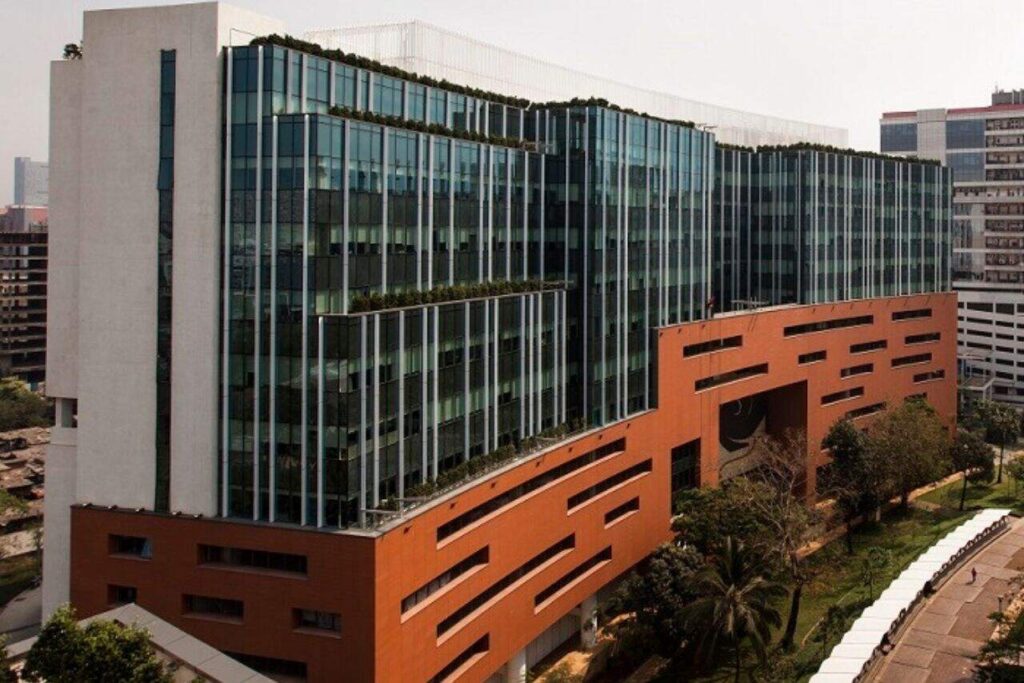
Synopsis: A little-known Mumbai office landlord backed by Singapore’s GIC has built one of the steadiest rental businesses in the listed realty space. With near-full occupancy, very high margins, rising FII interest and long-term contracts with global tenants. The company looks like a cash-flow compounder.
Most listed real estate companies are usually judged on launches, bookings, sales growth and new projects. This company looks very different. It is not trying to sell homes, chase new land banks across cities, or reinvent itself every few quarters. Instead, it owns a largely completed office asset, keeps it almost fully occupied, and earns steady rental income from global tenants.
That may not sound exciting at first, but it is exactly why Nirlon has been able to deliver unusually stable margins and predictable cash generation. Its stock has also quietly compounded, with a 10-year CAGR of 11 percent and a 5-year CAGR of 14 percent, while foreign institutional ownership has risen from 10.36 percent in September 2024 to 15.78 percent by March 2026, suggesting that “Big Money” is beginning to notice the story. One of the notable names in that FII list is Brookfield Corporation-backed BSREP IV FPI Two Holdings DIFC Ltd.
What Nirlon Actually Does
Nirlon was incorporated in 1958 and was once known for synthetic yarns and industrial rubber products. But since 2006, it has primarily been in the business of developing and managing commercial and IT-ITES real estate. Today, the company’s main value sits in Nirlon Knowledge Park, or NKP, a roughly 23-acre information technology park in Goregaon East, Mumbai. It also owns 75 percent of the undivided interest in around 0.05 million square feet in Nirlon House at Worli, but NKP is clearly the main business driver.
The final phase of NKP was completed in FY22, and the campus now has a total chargeable area of about 3.08 million square feet. GIC Singapore (Owned by Govt. of Singapore) became the majority shareholder and co-promoter in 2015 through its affiliate Reco Berry Private Limited, and currently holds 63.92 percent in the company. The broader promoter category accounted for 67.67 percent of shareholding as of December 31, 2025.
That structure matters because it explains why Nirlon behaves less like a speculative property developer and more like a mature rental asset owner. The company’s job today is straightforward. It leases out office space, collects license fees, recovers common area maintenance income, keeps the property in A-grade condition, and tries to push rental growth through contracted escalations and better renewals whenever space becomes available. In Q3 FY26, management said very clearly that with NKP practically at 100 percent occupancy, the main path to higher income is through contracted escalations in existing license agreements, and only secondarily through re-licensing at higher rates when a vacancy appears.
Why The Business Looks So Stable
The biggest reason this business looks unusually stable is occupancy. Nirlon’s occupancy rate for NKP and Nirlon House combined stood at 98.6 percent in Q2 FY26 and improved further to 99.7 percent in Q3 FY26. Vacant area fell from around 20,000 square feet at the end of September 2025 to only about 7,800 square feet by December 31, 2025. During Q2, about 2,60,000 square feet was licensed to tenants including Deutsche Bank, Barclays, MUFG, Citi and EY. Much of this came from space vacated earlier by Morgan Stanley, and management said the re-leasing happened at fairly competitive rates, with the vacancy gap not being very substantial. In Q3, Citi also renewed around 25,000 square feet.
CRISIL’s rationale supports this picture. It noted that committed occupancy at NKP has remained above 90 percent since March 2018. The agency also highlighted the park’s location in Goregaon East, with access to the Western Express Highway, the Jogeshwari-Vikhroli Link Road, railway stations and a metro station, which has helped attract leading banking and financial services occupiers such as JP Morgan, Citicorp, Deutsche and BNP Paribas. CRISIL also pointed out that most leave-and-license agreements carry lock-in periods of 3 to 5 years, lease periods of 4 to 10 years, and in-built escalations of 15 percent every 3 to 5 years for most licensees.
This is why Nirlon’s growth may look slow, but it is also why the company does not swing wildly from quarter to quarter. Once a landlord reaches near-full occupancy and signs long-term contracts with strong tenants, the business begins to look more like an annuity stream than a cyclical property play. Management said demand in the Goregaon micro-market remains fairly positive, especially from global capability centres, but also admitted that because the company has virtually no real vacancy, market demand matters less right now than it would for a landlord sitting on large unleased inventory.
The Real Reason Behind Those 78 Percent Margins
Nirlon’s margins are high because this is now a mature rental business with very little execution risk left in the core asset. In Q3 FY26, total income stood at Rs. 173 crores, EBITDA came in at Rs. 135 crores, and EBITDA margin was 77.93 percent. For the first nine months of FY26, total income was Rs. 509 crores, EBITDA was Rs. 400 crores, and EBITDA margin stood at 78.53 percent. Historical numbers show EBITDA margins staying around 79 to 80 percent through FY23, FY24, FY25 and 9M FY26, which tells you this is not a one-quarter spike. License fees have also moved up steadily over the last few years.
There is another subtle but important point here. Management said that after the Morgan Stanley exit, most of the newer agreements being signed are carrying annual escalation clauses, though this is still a relatively recent trend. In Q3, management also indicated that Citi’s renewed rent was “north of 185” per square foot, along with annual escalation, and that the new terms represented a meaningful increase over the old level. That suggests Nirlon is not just sitting on static leases. It is gradually improving the quality of its rental contracts even though headline vacancy is negligible.
Still, investors need to be careful not to overread the profit numbers in FY26. The company moved to the new tax regime from Q2 FY26 onwards and also re-measured deferred tax liability, reversing Rs. 69.50 crores in Q2. That is why PAT numbers in Q2 and 9M FY26 look unusually strong and are not directly comparable with earlier periods. Management itself made this point. So while PAT for 9M FY26 stood at Rs. 275 crores with a margin of 54.1 percent, the cleaner takeaway is that the underlying operating business is still growing at a much slower and steadier rate than the reported bottom line might initially suggest.
Strong Cash Flows, But Not A No-Risk Story
Nirlon’s balance sheet is better understood through cash flows than through absolute debt alone. As of December 31, 2025, the company had a total secured debt facility of Rs. 1,230 crores from HSBC, including an overdraft, with debt outstanding of Rs. 1,150 crores. CRISIL reaffirmed an AA+/Stable rating for the company. CRISIL also said the debt-to-lease rental ratio was around 2.05 times as of September 2025, while DSCR for fiscal 2025 was a strong 4.02 times. In simple terms, the company’s rental cash flows are comfortably supporting its debt at present. Liquidity is also backed by cash and equivalents of Rs. 294 crores as of August 31, 2025, a fully undrawn overdraft facility of Rs. 80 crores, and a debt service reserve account (The latest available cash and bank balance is at Rs. 325 crore, as mentioned by the management in Q3FY26 earnings call).
But this is not a zero-risk balance sheet. CRISIL flagged a bullet repayment of around 75 percent of the total debt in fiscal 2033, which creates refinancing risk. The lease rental discounting loan has a 10-year tenure, with a moratorium on principal repayment for the first five years and part repayment during the remaining tenure. CRISIL is comfortable for now because the loan-to-value ratio is expected to stay below 20 percent, and because there is no major capex expected in the near future. Management, too, said there are no significant plans for more volume at NKP or expansion into other cities. That makes the business more conservative, but it also means the next leg of growth is unlikely to come from fresh development.
The other side of this stability is concentration. CRISIL said the top seven licensees account for around 85 percent of gross lease rentals, and the largest licensee alone contributes 40 percent, which is assumed to be JP Morgan as 40% of the gross rental comes from the bank (as of September 2025). Around 31 percent of the area will also come up for renewal over the three fiscals through 2029. Management has argued that tenant quality is very strong and that actual exits over the history of NKP have been very few, but concentration risk is still real. If a large tenant leaves, the company would need to refill a meaningful block of space without losing pricing power. That is not impossible, as the Morgan Stanley vacancy showed, but it remains one of the key things investors should watch.
Why This Stock May Appeal To Stable Investors
Nirlon is unlikely to attract investors looking for explosive growth, aggressive land acquisition, or a dramatic rerating from project launches. What it does offer is a different profile. It has a completed and high-quality office asset, near-full occupancy, long-duration contracts, steady built-in escalations, strong operating margins, a majority shareholder is Singapore’s GIC, and a track record of meaningful dividends. The company’s dividend track record shows Rs. 26 per share in each of FY23, FY24 and FY25, while the board has already declared an interim dividend of Rs. 15 per share for FY26. CRISIL also noted that the company has paid annual dividends of around Rs. 234 crores over the past three fiscals.
That may explain why foreign investors are building exposure even though this is not a headline-grabbing name. Rising FII ownership, a Singapore promoter, a Brookfield-linked FPI among shareholders, and a decade-long compounding record together make Nirlon look more like a steady institutional cash-flow play than a retail frenzy stock. So this is best understood as a patient investor’s stock. Nirlon does not look like a story of rapid reinvention. It looks like a high-quality, slow-moving office rental business that may continue to quietly compound as long as occupancy, rental discipline and tenant quality remain intact.
Disclaimer: The views and investment tips expressed by investment experts/broking houses/rating agencies on tradebrains.in are their own, and not that of the website or its management. Investing in equities poses a risk of financial losses. Investors must therefore exercise due caution while investing or trading in stocks. Trade Brains Technologies Private Limited or the author are not liable for any losses caused as a result of the decision based on this article. Please consult your investment advisor before investing.
The post Hidden Gem: Realty Stock Delivering 78% Margins That Is An FII Favourite appeared first on Trade Brains.
Related Articles

Tata Motors: Can It Double Passenger Vehicle Volumes and Reach 20% Market Share by FY31?
Synopsis: Tata Motors targets strong PV growth with EV-led expansion, aiming to...
KPIT Technologies: Will Q1 Results Be Strong Enough For A Turnaround?
Synopsis: KPIT Technologies has spent the past year explaining why growth slowed...
Persistent Systems Shares: Can Europe Expansion and AI Deliver Long-Term Growth?
Synopsis: Persistent Systems remains focused on expanding its business through s...

Oriana Power: After Missing FY26 Expectations, Can ₹7,000 Cr Order Book Change the Narrative?
Synopsis: Oriana Power missed its FY26 expectations due to commodity inflat...