Bitcoin Bearish Positioning Persists As Funding Rates Hold Negative
Alex Smith
3 months ago

Data shows the Bitcoin perpetual futures market has seen a negative Funding Rate recently, suggesting a bearish sentiment is dominant.
Bitcoin Perpetual Futures Traders Are Betting On The Short Direction
As highlighted by Glassnode analyst Chris Beamish in an X post, the Bitcoin perpetual futures Funding Rate has been negative recently. The “Funding Rate” here refers to an indicator that measures the amount of periodic fee that traders on the various centralized derivatives exchanges are paying each other right now.
When the value of the metric is positive, it means the long holders are paying a premium to the short ones in order to hold onto their positions. Such a trend implies a bullish sentiment is shared by the majority.
On the other hand, the indicator being under the zero mark implies the shorts outweigh the longs and a bearish mentality is the dominant force in the perpetual futures market.
Now, here is the chart shared by Beamish that shows the trend in the 3-day moving average (MA) of the Bitcoin Funding Rate over the past few months:
As displayed in the above graph, the 3-day MA of the Bitcoin Funding Rate was positive earlier even as the cryptocurrency’s price went through a bearish shift. This suggests that perpetual futures traders were trying to bet on a market reversal back to a bullish trend.
In March so far, BTC has found some stability and made some recovery, but from the chart, it’s visible that the market expectations have now flipped, with shorts instead dominating. This also didn’t change during BTC’s recent rally above $75,000.
Generally, the side of the market that’s stronger is more vulnerable to mass liquidation events. As such, while the long investors were getting squeezed during the downtrend, it could be the short ones who might be at risk now.
In some other news, Glassnode has revealed in its latest weekly report how a supply gap exists between the $72,000 and $82,000 levels on the UTXO Realized Price Distribution (URPD).
The URPD tells us about the total amount of supply that was last moved at the various price levels visited by Bitcoin in its history. From the chart, it’s apparent that this indicator shows a chasm near the recent price levels, implying not a lot of supply has cost basis there.
Generally, supply walls above the spot price act as resistance levels as investors exit at their break-even level fearing price pullbacks. Though, while there isn’t much in the way of this on-chain resistance until $82,000, BTC’s recent attempt to get through the range still ended up in failure.
BTC Price
Bitcoin has dropped back to the $70,400 level following its latest retrace.
Related Articles
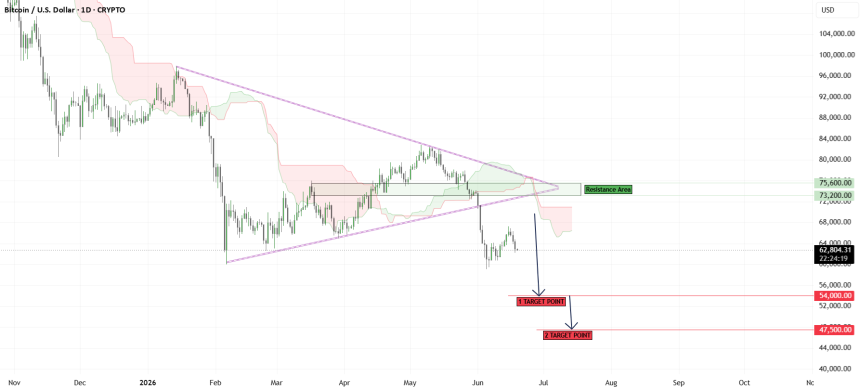
Bitcoin Bears Eye Lower Levels As TradingView Analysts Flag Failed Recovery
TradingView analysts warn Bitcoin's rebound may still be a resistance retest as...

Bitcoin Reclaims $63,500 As Traders Watch For Squeeze Toward $67,000
Bitcoin bulls are watching the $63,500 support zone as traders map a potential s...

Bitcoin Analysts Split Between Buyer Demand And Resistance Ceiling Near $65,000
Bitcoin analysts are split as BTC shows buyer demand but still faces a resistanc...

Bitcoin Faces Key $64,100 Resistance As Analyst Watches Fib Reaction Zone
An X analyst says Bitcoin is approaching local H4 resistance near $64,100, a lev...